Digital evidence is now central to investigative work. Photos, videos, call records, screenshots, GPS exports, documents, email files, social media captures, invoices, and surveillance clips can all become part of a case record. The challenge is not simply collecting evidence. The challenge is preserving enough context that the evidence remains useful, understandable, and defensible later.
The NIJ's chain of custody overview explains why documentation around evidence handling matters before trial.
Chain of custody is the documented history of who had control of evidence, when they had it, what they did with it, and how it was stored or transferred. In legal, insurance, corporate, and private investigation contexts, weak evidence handling can undermine otherwise strong work. Even when a matter never reaches court, poor evidence organization creates operational risk, client confusion, and unnecessary rework.
Start with a written evidence workflow
Every investigative organization should document how digital evidence is collected, named, stored, reviewed, shared, exported, and retained. A written workflow reduces inconsistency and gives new staff a clear standard. It also helps managers audit whether evidence handling is actually happening the way the agency expects.
The workflow should define where original files are stored, who may upload evidence, how files are named, how case associations are made, how edits or annotations are handled, and when exports are permitted. It should also address what investigators should avoid, such as forwarding sensitive files through personal email or renaming media in a way that destroys context.
Preserve original files whenever possible
Original files matter because they may contain metadata, timestamps, embedded device information, or file structure that supports later review. Investigators often need working copies for reports or client communication, but original evidence should be preserved separately from edited versions. If an image is cropped for a report, the original should remain available. If video clips are shortened for review, the source file should still be retained.
Preservation does not mean every file is automatically admissible. It means the agency is reducing unnecessary questions about whether the evidence was altered, misplaced, or separated from its source.
Use structured case associations
Evidence is more valuable when it is connected to the case, subject, date, activity, and investigator who collected it. A folder full of files may technically store evidence, but it does not explain the evidence. Structured associations help teams answer questions quickly: Which subject does this photo relate to? Which surveillance period produced this video? Was this document uploaded by the investigator or provided by the client? Was the file used in a report?
An evidence organizer for investigators should allow evidence to be linked to the relevant case record and, where appropriate, to subjects, updates, tasks, and activities. This creates a more complete operational timeline.
Keep evidence attached to the case record.
CaseWyze helps investigative teams keep case files, subjects, updates, tasks, and finance records connected so digital evidence does not become a disconnected folder problem.
Start your 14-day free trialControl access with role-based permissions
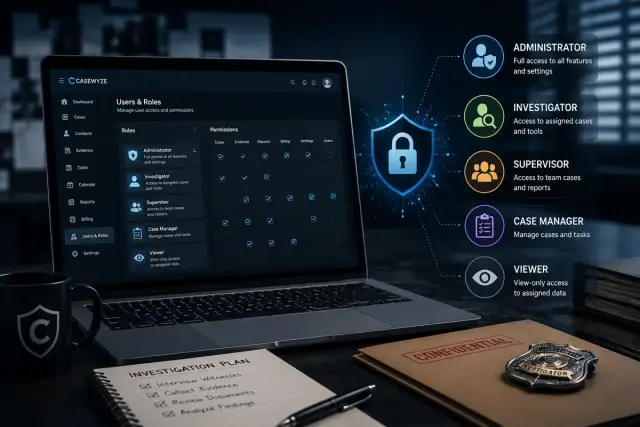
Not everyone who works around a case needs access to every file. A vendor may need a task assignment but not the full case history. An investigator may need subject details and upload rights but not financial administration. A client may need selected deliverables but not internal notes. Role-based permissions reduce the risk of unnecessary exposure.
Access control is part of evidence management. If an agency cannot explain who could view or download sensitive materials, it has a documentation gap. Good platforms make access narrower, clearer, and easier to revoke when a user leaves the organization.
Document uploads and material events
A practical chain-of-custody workflow should capture important events: upload date, uploader, file name, case association, version or replacement activity, exports, and significant access changes. This does not need to be burdensome. The best systems create audit context as a byproduct of normal work.
Manual notes may still be necessary for physical evidence, unusual transfers, or client-specific requirements. But for digital materials, automated timestamps and user activity can create a stronger baseline record than memory-based documentation.
Separate internal notes from client-ready evidence
Investigative teams often need candid internal notes. Those notes should not accidentally become client-facing deliverables. Clear separation between internal updates, evidence files, report drafts, and final exports helps protect both the agency and the client relationship.
This separation also improves speed. When it is time to assemble a report, the team can distinguish supporting evidence from operational chatter, finance notes, or review comments.
Use consistent naming without relying only on names
File naming conventions help, but they should not be the only organizational method. Names can be inconsistent, shortened, duplicated, or changed. A better approach combines naming rules with structured metadata: case number, subject, activity type, date, uploader, and tags.
For example, a surveillance photo should be discoverable by the case, the subject, the date, and the related update, not only by whether someone typed the right file name.
Plan for exports before you need them
Evidence exports are often urgent. A client, attorney, insurer, or internal reviewer may request materials on short notice. Agencies should plan how evidence will be exported, what file structure will be used, how sensitive items will be excluded, and what documentation will accompany the export.
Export planning is especially important when a case contains mixed material: client documents, field media, internal notes, invoices, and subject records. A clear system prevents accidental overproduction and helps teams provide exactly what is needed.
Retention and deletion require policy discipline
Digital evidence should not live forever simply because storage is cheap. Retention requirements may depend on contracts, litigation needs, regulatory expectations, insurance requirements, or agency policy. Teams should define retention schedules and deletion procedures before storage becomes unmanageable.
At the same time, deletion should be controlled. If a matter is subject to preservation obligations, automatic or careless deletion can create serious risk. Evidence retention is both an operational and legal issue, and agencies should seek legal guidance for their specific obligations.
Separate internal notes from deliverable evidence
Investigative teams often store several types of material inside a case: raw evidence, working notes, internal strategy, client communications, report drafts, billing records, and final deliverables. Treating every item the same creates confusion. A stronger evidence workflow distinguishes between materials that may need to be produced, materials used for internal review, and materials prepared for client delivery.
This separation helps agencies avoid accidental disclosure. It also makes exports cleaner because the team can identify which files are original evidence, which are annotated working copies, and which are final client-ready materials. In a busy agency, this distinction saves time and reduces risk when a client, attorney, insurer, or court requests records.
Train investigators on file handling habits
Even the best system depends on user behavior. Investigators should understand how to upload files, when to preserve originals, how to label evidence, what information to include in notes, and which sharing methods are approved. Training does not need to be complicated, but it should be explicit.
Useful training topics include avoiding personal cloud drives, protecting mobile devices, confirming the correct case before upload, documenting collection context, and reporting accidental disclosure quickly. Agencies should also train staff on what not to do: do not strip context from files, do not mix evidence from different cases, and do not use unapproved consumer tools for sensitive client materials.
Review evidence workflows regularly
Evidence practices should evolve with the agency. New clients may impose stricter handling requirements. New jurisdictions may create different privacy expectations. New file types, devices, or AI-assisted tools may introduce additional review needs. A quarterly or semiannual review of evidence workflows can help agencies catch problems before they become serious.
During a review, managers should ask whether evidence is consistently attached to the correct case, whether access permissions still match staff responsibilities, whether exports are documented, and whether retention rules are understood. This kind of review is not bureaucracy for its own sake. It is operational hygiene for sensitive investigative work.
Use technology to support, not replace, professional judgment
Evidence management software can centralize records, apply access controls, capture timestamps, and make files easier to retrieve. It cannot decide whether a collection method was lawful, whether a disclosure is appropriate, or whether a particular item should be preserved under a legal hold. Those decisions remain the responsibility of the agency and its advisors.
The most mature agencies treat software as the system of record while maintaining human review for legal, ethical, and client-specific decisions. That balance is what turns digital evidence management from simple storage into a disciplined professional workflow.
A field-ready digital evidence checklist
Investigators should have a simple checklist they can follow under real working conditions. Before collection, confirm the case, assignment, subject, and purpose of the material. During collection, preserve original files where possible, avoid unnecessary edits, and document the date, time, location, device, and context that may later matter. After collection, upload materials to the correct case promptly, attach them to the relevant subject or activity, and avoid storing the only copy on a personal device.
Managers should also define what happens after upload. Who reviews evidence? Who can mark it as report-ready? Who can export it? How are duplicate files handled? How are sensitive materials restricted? These questions are easier to answer before a client urgently requests records or a legal deadline appears.
A checklist does not eliminate the need for judgment, but it makes good behavior more repeatable. That is especially valuable when agencies rely on multiple investigators, vendors, or offices. Consistency is one of the strongest defenses against evidence confusion. When every user follows the same basic evidence workflow, the agency can search faster, report more accurately, and explain its handling practices with more confidence.
Agencies should also make the checklist easy to find. It can live inside the case management system, onboarding materials, or field procedures. The important point is that evidence handling should not depend on memory during a stressful assignment. A clear, repeatable standard helps investigators protect the record even when the work is moving quickly.
Conclusion
Digital evidence management is about trust. Investigative teams need to trust that evidence is complete, organized, accessible to the right people, and protected from unnecessary exposure. Clients and legal stakeholders need confidence that evidence was handled with care.
Software alone cannot create a defensible chain of custody. But the right software can support disciplined workflows by centralizing case context, controlling access, recording activity, and keeping evidence connected to the investigation it supports.
FAQ
What should be included in a digital chain-of-custody record?
A useful record may include upload date, uploader, original file name, case association, access history, transfer or export events, and relevant notes about collection or preservation.
Should investigators edit original evidence files?
Original files should generally be preserved. Edited copies may be used for reports or presentation, but source materials should remain available where appropriate.
Can CaseWyze replace legal advice on evidence handling?
No. CaseWyze can help organize and document investigative records, but agencies should consult qualified legal counsel for jurisdiction-specific evidence obligations.