Efficiency in private investigation rarely comes from one dramatic change. It comes from removing small sources of friction that repeat every day: searching for a case note, rebuilding a client update, checking whether a retainer is nearly exhausted, finding a subject photo, assigning a task, or reconciling time entries after the work is already done. Those moments look harmless in isolation. Across a busy agency, they become hours of lost billable time.
Private investigator case management software exists to reduce that operational drag. The best systems do more than store records. They create a shared operating environment where clients, contacts, cases, subjects, updates, tasks, events, time, expenses, invoices, and reports are connected. For private investigators, SIU teams, legal support professionals, and corporate investigations departments, that connection is where efficiency compounds.
Why investigative work becomes inefficient
Investigations are information-heavy by nature. A single case can include client intake notes, assignment details, subject identifiers, surveillance logs, invoices, photos, video clips, vendor communications, court dates, insurance documents, location notes, and internal decisions. If those pieces live in separate tools, the team has to reconstruct the case every time someone needs an answer.
Common inefficiencies include duplicate data entry, inconsistent naming conventions, missing context during handoffs, disconnected billing records, and client updates that require manual assembly. Agencies often tolerate these problems because each workaround feels familiar. A spreadsheet tracks budgets. Email handles client requests. A folder stores media. A calendar holds surveillance windows. A separate invoice tool handles billing. The problem is not that any one tool is bad; the problem is that none of them understand the case as the central object.
One case record reduces context switching
A strong case management platform gives every case a home. Instead of asking, “Where did we put that?” the team can open the case and see the client, account, contacts, assigned investigators, subjects, updates, tasks, events, documents, financial activity, and status history. This reduces context switching, which is one of the most expensive hidden costs in investigative operations.
When an investigator returns from the field, they should not need to update a spreadsheet, email an admin, rename files, message a manager, and separately write a billing note. A unified workflow lets the investigator log activity once and let that activity support reporting, invoicing, budget tracking, and case history.
CaseWyze connects the operational record.
CaseWyze brings cases, subjects, updates, tasks, calendar events, time, expenses, and invoices into one workspace so agencies can spend more time investigating and less time rebuilding context.
Start your 14-day free trialTemplates make repeatable work faster
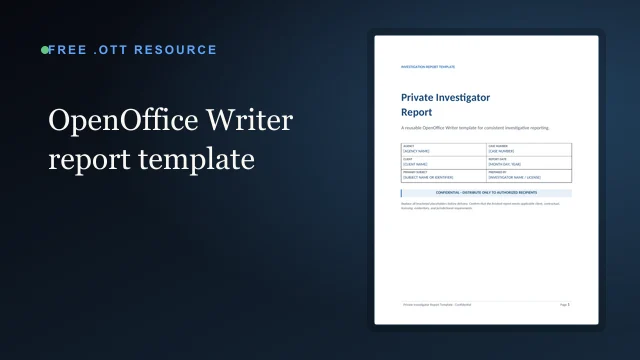
Many investigative assignments follow recognizable patterns. A domestic surveillance case, insurance activity check, background investigation, process support matter, or corporate internal investigation may have different details, but the workflow often repeats. Case templates help agencies standardize intake, required fields, common tasks, budget defaults, and reporting expectations.
Templates reduce mistakes because the system prompts users for the information that matters. They also speed up onboarding for new staff. Instead of relying on tribal knowledge, the agency can encode its best practices into the workflow. This is especially important for growing teams, where inconsistent process becomes more expensive as volume increases.
Better subject records improve searchability
Subjects are often the heart of an investigation. A subject may be a person, vehicle, business, device, address, or custom entity. If subject information is buried in narrative notes or file names, investigators lose valuable time searching for identifiers. Structured subject records allow agencies to store names, aliases, photos, vehicles, phone numbers, addresses, relationships, and case associations in a way that can be searched and reused.
This matters when a subject appears across multiple cases, when a client asks for a quick update, or when an investigator needs to confirm a plate, device, or business relationship before heading into the field. Good structure does not replace investigator judgment. It gives judgment better information to work with.
Updates become client-ready faster
Client communication is one of the most visible parts of investigative work. Even when the fieldwork is excellent, a slow or disorganized update can make the agency appear less professional. Case management software helps by capturing updates as the case progresses. Surveillance notes, accounting notes, internal reviews, AI-assisted summaries, and final reporting inputs can all live in the case record.
The AI investigation platform guide explains how review-first summaries, source context, and human approval can support that workflow without replacing investigator judgment.
A focused staff updates workflow also gives managers a cleaner record for review, handoffs, and client-ready communication.
Instead of writing client updates from scratch at the end of the week, managers can review a timeline of meaningful activity and turn it into a polished communication. This improves responsiveness and reduces the risk of leaving out important context.
Time, expenses, and budgets belong inside the case
Efficiency is not only about case notes. It is also about money. Agencies need to know whether a case is profitable, whether a retainer is running low, whether expenses have been captured, and whether an invoice reflects the work performed. When finance lives outside the case management workflow, billing becomes a reconstruction exercise.
Private investigator billing software allows agencies to connect time and expenses to billing as the work happens. Budget caps, retainer balances, invoice generation, and financial reporting become part of the operational record. That reduces leakage, improves cash flow, and helps managers make better decisions before a case exceeds scope.
Tasks and calendars create accountability
Investigations depend on timing. A missed follow-up, forgotten review, or unassigned task can damage client trust. A case management platform should make work visible. Tasks should have owners and due dates. Events should connect to cases. Calendar views should make upcoming commitments obvious. Managers should be able to see what is overdue, what is scheduled, and what needs review.
This visibility is especially valuable when multiple investigators, admins, vendors, or managers touch the same case. Accountability does not require micromanagement. It requires a system where the next action is clear.
Reporting becomes a byproduct of good workflow
Many agencies treat reporting as a separate administrative project. The more effective approach is to capture structured information throughout the case so reporting becomes easier at the end. If updates, activities, expenses, photos, subject records, and key events are already organized, reports take less time and are less likely to omit important details.
For private investigators and legal support teams, this also supports professionalism. Clean reports improve client confidence and reduce back-and-forth questions. For SIU and corporate investigations teams, consistent reporting supports internal review, compliance, and auditability.
Choosing the right investigation software
When evaluating investigation case management software, agencies should look for more than a file repository. The platform should support client and account records, structured contacts, case templates, subject management, updates, tasks, events, calendar views, time tracking, expense management, budgets, invoices, permissions, and reporting. It should be easy enough for field investigators to use and structured enough for managers to trust.
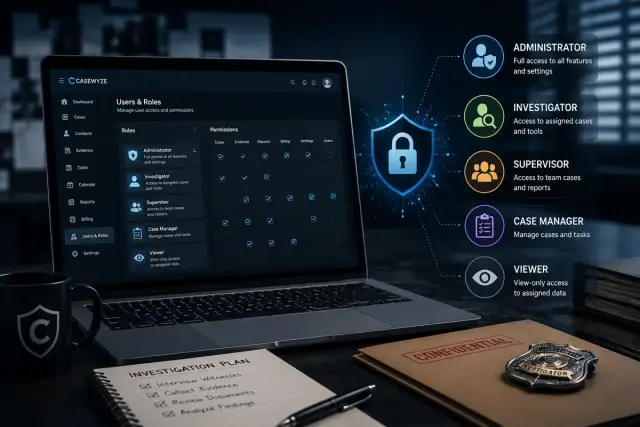
The right platform should also respect the sensitivity of investigative data. Role-based permissions, authentication controls, audit-ready records, and secure infrastructure are not optional in a modern investigative environment.
Before choosing a platform, use our investigation software buyer’s checklist to test a sample case, score essential requirements, and compare your expected costs during a free trial.
Field access should work from a mobile browser
Field investigators often need case details, subject information, tasks, updates, time entries, and expense records while they are away from the office. CaseWyze is web-based and its responsive interface can be opened in a supported mobile browser, but it is not currently a native iOS or Android app. Agencies that require offline capture, background GPS tracking, or app-store deployment should verify those requirements separately when comparing platforms.
How efficiency shows up in daily agency operations
The best way to evaluate efficiency is to look at ordinary days, not ideal demonstrations. A client calls asking whether a report is ready. A manager needs to know which investigator is assigned to tomorrow morning surveillance. An admin wants to see whether the retainer has enough remaining balance before authorizing more hours. A field investigator needs the subject vehicle description without searching through an old email thread. These are the moments where a unified system proves its value.
When a team has to answer each question by opening a different tool, the agency loses speed and consistency. When the case record contains the relevant operational data, those answers become routine. That does not just save time. It helps the agency appear more responsive, organized, and professional to the clients who are paying for the work.
Efficiency also improves quality control
Speed alone is not the goal. Investigative agencies need faster workflows that also protect quality. Case management software supports quality control by creating consistent places for notes, updates, evidence, task outcomes, invoices, and approvals. Managers can review work in context instead of piecing it together from emails, messages, and attachments.
This matters for growing agencies because quality control becomes harder as more people touch the work. A solo investigator may keep a great deal of context in memory. A multi-person agency cannot rely on memory. It needs a shared system that makes the important parts of the case visible and reviewable.
Implementation should be practical
Agencies do not need to rebuild every workflow on day one. A practical rollout usually begins with the areas that create the most repeated administrative work. Start with intake, case creation, subject records, tasks, updates, time tracking, and expenses. Once those habits are established, expand into reporting templates, budget review, permissions, dashboards, and more advanced automation.
For a broader operating lens, the SBA's manage your business guidance covers practical management areas that small agencies often need to systematize.
The key is adoption. The best platform is the one the team will actually use during the work, not after the work. If investigators can log updates quickly, attach files without friction, and see their tasks clearly, the system becomes part of the operating rhythm rather than an end-of-week chore.
Agencies that accept work through email can also begin with a structured case request workflow, separating proposed intake from approved active casework.
A practical efficiency checklist for private investigators
Agencies evaluating investigation case management software should look at the workflows that repeat most often. Can a new case be created quickly from a complete intake record? Can the team connect the client, contacts, subjects, activities, files, calendar events, and billing records without duplicate entry? Can a manager open the case and understand current status within a minute? Can an investigator update the record from the field without waiting until the end of the day?
It is also important to evaluate financial and reporting workflows. Time entries should connect to the case. Expenses should be captured while the context is fresh. Retainers and budgets should be visible before work exceeds scope. Client updates should draw from the activity history instead of requiring a blank-page rewrite. Final reports should be easier because the record has been maintained throughout the case.
Finally, agencies should consider operational control. The platform should support separate users, role-based permissions, searchable records, an evidence organizer for case-specific files, clear task ownership, and a clean path from active investigation to closeout. If a tool only stores documents, it may help with filing, but it will not meaningfully improve agency efficiency. The highest-value systems reduce administrative friction across the full case lifecycle.
Conclusion
Investigation case management software improves efficiency by reducing context switching, standardizing repeatable workflows, connecting financial activity to casework, and making updates easier to produce. For agencies that want to grow without adding unnecessary administrative burden, a unified platform becomes a strategic advantage.
CaseWyze is built for that operating reality. It gives investigative teams one place to manage clients, cases, subjects, updates, tasks, events, calendars, and finance, helping agencies move faster while maintaining a clearer record of the work.
FAQ
What is private investigator case management software?
Private investigator case management software is a platform for organizing cases, clients, subjects, updates, tasks, documents, evidence, time, expenses, billing, and reporting in one system.
Can case management software replace spreadsheets?
For most investigative workflows, yes. Spreadsheets can still be useful for analysis, but they should not be the primary system for managing sensitive case operations.
Does software make investigators less flexible?
Good software does the opposite. It standardizes the administrative layer so investigators have more room to focus on judgment, fieldwork, and client communication.